





Now Reading: Nepal’s Clay Bird Wins Best Animation Short at Los Angeles Film Awards
-
01
Nepal’s Clay Bird Wins Best Animation Short at Los Angeles Film Awards

Krishna Paksha Thapa | Jerusalem
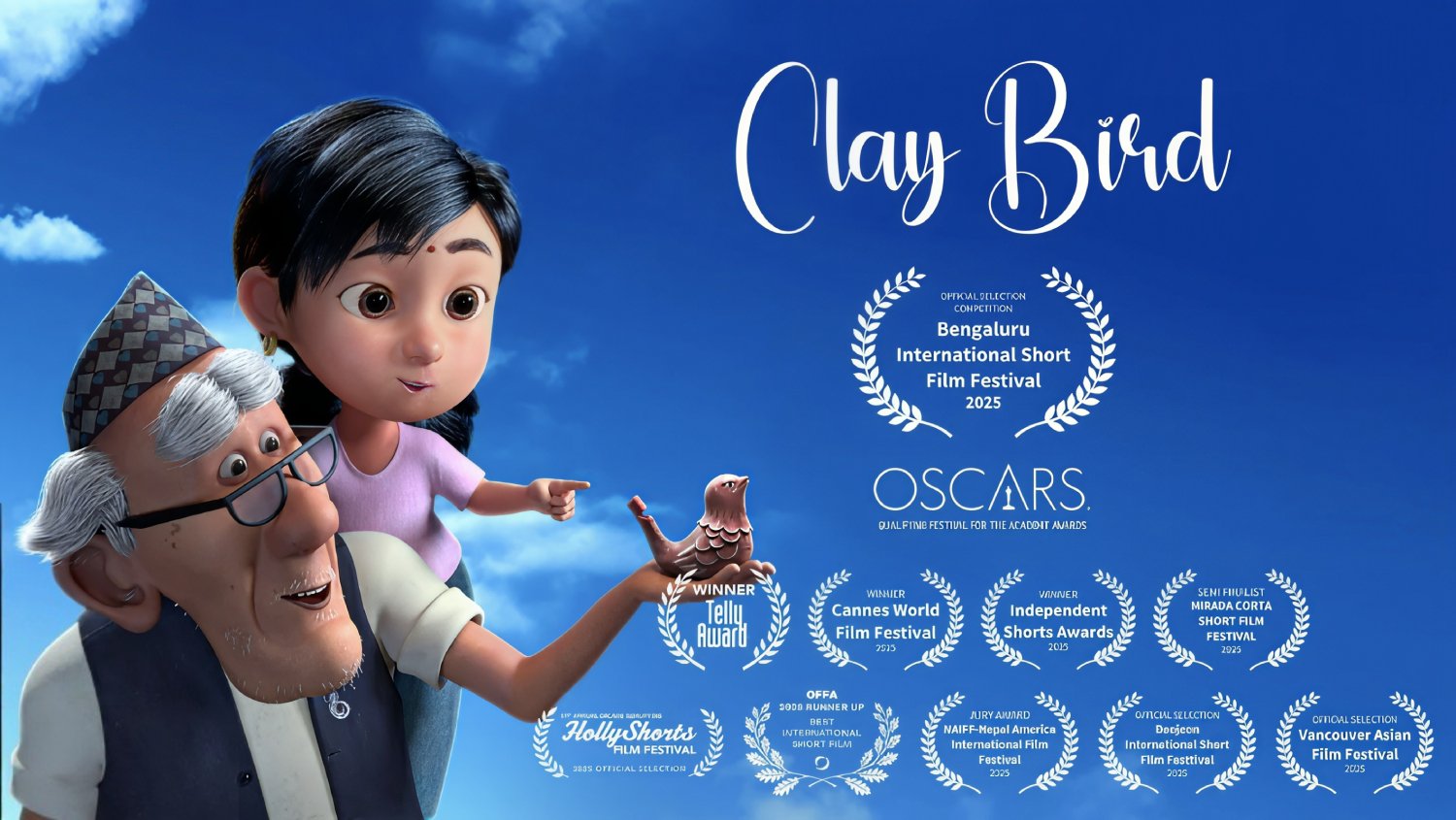
Nepal’s animation industry has reached another major milestone after Clay Bird, an animated short directed by acclaimed animator and visual effects artist Kiran Bhakta Joshi, won the Best Animation Short award at the prestigious Independent Shorts Awards in Los Angeles.
The award was presented during the 7th Annual Independent Shorts Awards ceremony held at Regal LA Live in Los Angeles on September 6, 2025. Only 28 films were honored from a pool of 3,249 submissions received from 65 countries between June 2024 and June 2025, making the competition one of the most selective international showcases for short films. Clay Bird emerged as the year’s top animated short among thousands of entries from around the world.
The recognition adds to the film’s growing list of international achievements. Earlier in May 2025, Clay Bird had already received recognition from the Independent Shorts Awards, underscoring its consistent success on the global festival circuit.

Director Kiran Bhakta Joshi and producer Deepa Chipalu Joshi were in Nepal during the ceremony and were unable to attend. The award was accepted on their behalf by their close friend, Dunya Djordjevic.
A Story Rooted in Nepal
Clay Bird is a deeply emotional story exploring intergenerational grief through a creative collaboration between Nepal and the United States. Produced in Nepal with a predominantly Nepali creative team, the film features performances by Bhumika Shrestha in the dual roles of Sichu and the mother, Danil Chitrakar as the grandfather, and Ashriya Maharjan as the teacher.
The film’s original score was composed by Prasanna Shakya, and it was produced by Incessant Rain Studios.
This is not the film’s first international success. Clay Bird has previously earned accolades at the Cannes Film Festival and the Telly Awards, where it received recognition alongside productions from major global studios including Pixar and ABC News Studios.
The Vision Behind the Film
Kiran Bhakta Joshi is widely regarded as one of the pioneers of Nepal’s animation industry.
Born in Kathmandu, Joshi earned both his bachelor’s and master’s degrees in Computer Science and Engineering from California State University, Long Beach. In 1991, he joined Disney to work on its computer animation production system, launching a career that would span some of the studio’s most celebrated animated films.
During his years at Disney, Joshi contributed to classics including Beauty and the Beast, Aladdin, The Lion King, The Hunchback of Notre Dame, and Atlantis. He also co-developed the groundbreaking herd simulation system used for the famous wildebeest stampede sequence in The Lion King, and later supervised the early development of Tangled and Frozen.
In 2007, Joshi returned to Nepal and founded Incessant Rain Studios, which has since become one of the country’s leading animation and visual effects studios. He also co-directed and produced the award-winning documentary Moving Mountains: The Awakening, based on Nepal’s devastating 7.8-magnitude earthquake in 2015.
Building Nepal’s Animation Industry
For Joshi, Clay Bird represents more than a successful film. It reflects years of work aimed at proving that animation can become a viable creative industry in Nepal rather than being viewed merely as children’s entertainment.
His studio also runs a free six-month training program for aspiring young animators, helping develop local talent and strengthen Nepal’s growing animation ecosystem.
Joshi’s long-term vision is to bring stories inspired by the Himalayas—including magical yetis, snowboarding yaks, and Nepal’s rich folklore—to international audiences. He believes the future of Nepali animation lies not in imitating the West, but in telling authentic stories rooted in Nepal’s own culture and traditions.
A Proud Moment for Nepal
The success of Clay Bird is more than an individual achievement. It signals the growing international recognition of Nepal’s creative talent and animation industry.
With decades of Hollywood experience brought back home, Kiran Bhakta Joshi has demonstrated that world-class animated storytelling can be created from Nepal. His latest international award stands as an inspiration for a new generation of Nepali animators and filmmakers, showing that local stories can resonate with audiences across the globe.

Krishna Paksha Thapa (KANXEY) is an art lover, illustrator, and storyteller from Nepal (Now in Israel). An independent creator who loves to write and paint, he brings stories to life through sketches, words, and visual expression.